Companies featured here may provide compensation for click throughs. This is how I maintain free research for consumers. My full disclosure of who I invested with is on this page for transparency.
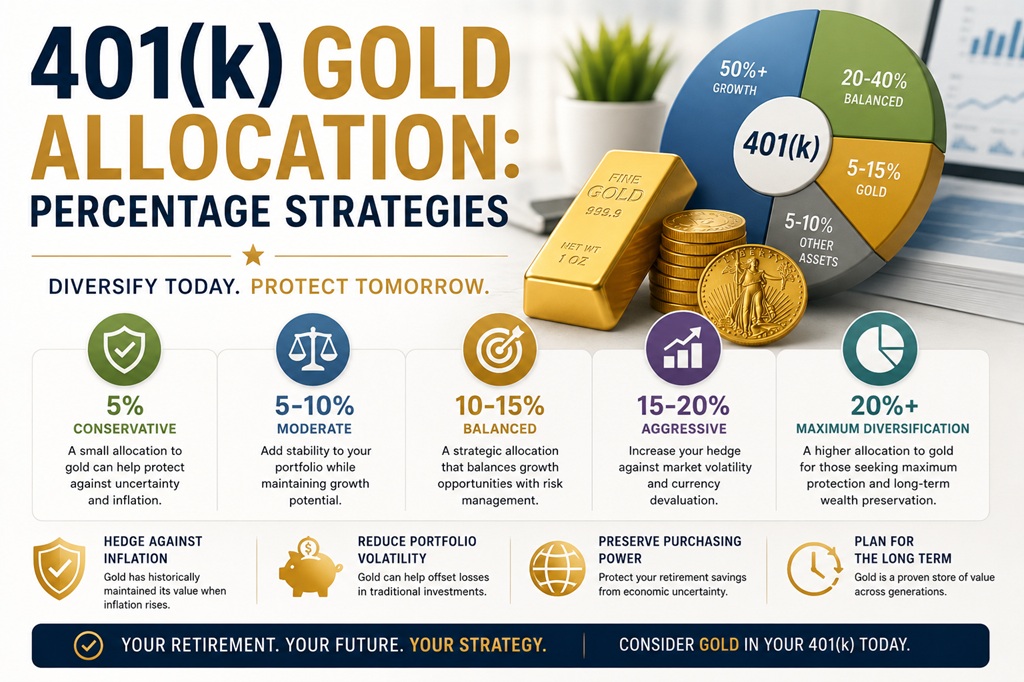
TL;DR: Most retirement investors anchor 5 to 20 percent (the working allocation band) of a portfolio in precious metals. A conservative sleeve runs 5 to 10 percent, a moderate sleeve 10 to 15 percent, and an aggressive sleeve 15 to 20 percent. You reach the position by rolling 401(k) dollars into a self-directed IRA with a direct transfer. I moved mine to Goldco at the 25,000 dollar minimum.
Disclosure: Companies featured here may provide compensation for click throughs. This is how I maintain free research for consumers. My full disclosure of who I invested with is on this page for transparency.
Disclaimer: This article is educational and is not financial, tax, or legal advice. Consult a qualified professional before any retirement-account decision.
What Percentage of a 401(k) Should Go Into Gold?
Most retirement investors put 5 to 20 percent (the broadly recommended band) of a portfolio into physical precious metals, and the exact number inside that range comes down to four things. Your time horizon, your risk tolerance, how diversified the rest of the account already is, and how much of a documented crisis hedge you want. The band is the consensus. The point inside it is the decision.
The single number I get asked for most is a clean percentage, and the honest answer is that one number doesn’t fit every saver. A 40-year-old with a long runway and a heavy equity tilt sits at a different point than a 63-year-old who wants the account to stop swinging. What both share is the band itself, because below 5 percent (a token position) the metal can’t move the portfolio, and above 20 percent (an over-concentrated weight) you give up too much of the equity growth that funds a retirement.
This site is built around the 401(k) rollover, so the allocation question always rides alongside a mechanics question. You can’t hold bullion in a standard workplace plan. You reach the position by rolling a portion of the 401(k) into a self-directed IRA that an IRS-approved custodian administers. The percentage you pick is the strategy. The rollover is the plumbing. Get both right and the account does what a retirement account is supposed to do, which is grow through the good years and hold its footing through the bad ones. So how do you set the number and hold it?
Why Does the Allocation Percentage Matter More Than Timing?
The percentage matters more than timing because a fixed allocation band forces you to buy low and sell high automatically, while timing the metal is a guess almost nobody wins. Pick a target weight, rebalance back to it once a year, and the band does the discipline for you. The allocation, according to Tim Schmidt, summarizing the framework on a recent operator call, is the part the investor actually controls.
People do recommend 5 to 20 percent. Most people go between 5 and 10. If you stay within that number as your portfolio either earns or loses money over the years, that’s probably a good range to just keep inside.
Tim Schmidt Sr., May 2026 (operator call)
The case for holding the position through cycles rests on the data. According to World Gold Council research on the metal as a strategic asset, bullion has outpaced the United States and world consumer price indices since 1971 (the start of the floating-rate era), and in years when inflation ran between 2 percent and 5 percent (a moderate-inflation band), the price of the metal rose 10 percent per year on average. That’s the behavior an allocation is meant to capture, and you only capture it by being in the position before the cycle turns.
A fixed band also strips the emotion out. When equities rip higher, your metal weight drifts below target and you add to it. When markets crater, the precious-metal sleeve usually holds or climbs, drifts above target, and you trim it back. You’re buying weakness and selling strength without having to predict anything. Why try to time a market when a rebalancing rule does the work?
The cadence is what keeps it honest. Once a year is plenty for a retirement account, and tying the rebalance to a fixed date, your birthday or the first week of January, removes the temptation to tinker. You check the weight, compare it to your target, and move the position back into the band. There’s no forecasting and no second-guessing, just a rule you follow whether the headlines are calm or panicked. The investors who struggle are the ones who treat the allocation as a live trade instead of a standing policy, and they tend to buy after a rally and sell after a scare, which is exactly backward.
The Conservative Sleeve: What Does a 5 to 10 Percent Allocation Look Like?
A conservative sleeve runs 5 to 10 percent (the entry-level band) of the retirement portfolio in physical metal, and it suits savers who want diversification without giving up meaningful equity growth. On a 200,000 dollar account, that’s 10,000 dollars to 20,000 dollars in bullion, with the remaining 90 to 95 percent compounding in conventional assets.
This is the right starting point for two groups. Younger investors early in the accumulation phase who have decades of runway, and cautious savers who want a measurable hedge but aren’t convinced metal should be a large slice. The diversification benefit is real at this weight, and the opportunity cost is small. You’re insuring the portfolio, not betting it.
The conservative sleeve is also where most first-time rollovers land. A saver moving a portion of a workplace plan for the first time rarely jumps to a 20 percent weight. Starting at 5 to 10 percent (a deliberate floor) lets you learn the mechanics, see the fee structure, and watch how the position behaves before scaling up. The 7,500 dollar IRA contribution limit for 2026 (the annual cap under Notice 2025-67) means you can keep adding modestly each year on top of the rollover.
One caution at this weight. A sleeve under 5 percent (a sub-token slice) tends to be noise. If you’re going to do this, commit to at least the 5 percent floor so the allocation can actually register when conventional assets correlate downward. Anything thinner and you’ve taken on the storage cost without buying enough of the hedge.
The Moderate Sleeve: When Does 10 to 15 Percent Make Sense?
A moderate sleeve of 10 to 15 percent (the middle band) makes sense for serious retirement savers who want genuine inflation protection and non-correlation without over-concentrating. On a 200,000 dollar portfolio, that’s 20,000 dollars to 30,000 dollars in bullion. This is the range I consider optimal for most investors with a 10-year-plus horizon.
The reason this band is the workhorse is balance. At 10 to 15 percent (a meaningful but measured weight), the metal is large enough to anchor the account during a crisis and small enough that the equity portion still drives long-term growth. You get the documented hedge behavior and you keep the compounding engine running.
The moderate sleeve fits the mid-career saver squarely. Someone in their fifties who’s funding a 401(k) at the 24,500 dollar elective-deferral limit for 2026 (the workplace cap), adding the 8,000 dollar catch-up (the 50-plus amount), and rolling an older balance into a gold IRA is the textbook case. The position is sized to matter without crowding out the growth that still has a decade to work.
Holding 10 to 15 percent (the optimal band for many) also means the annual rebalance produces real trades. A 5 percent drift on a 30,000 dollar sleeve is 1,500 dollars (a tradeable amount), enough to justify the buy or the trim. The discipline shows up as actual transactions rather than rounding error, which is part of why the moderate band tends to outperform a set-and-forget approach over a full cycle. Is your sleeve big enough that rebalancing actually does something?
The Aggressive Sleeve: Who Should Hold 15 to 20 Percent?
An aggressive sleeve of 15 to 20 percent (the top of the band) suits investors close to or already in retirement, and anyone carrying a concentrated equity position who wants a heavy documented hedge. On a 200,000 dollar account, that’s 30,000 dollars to 40,000 dollars in physical metal. The weight reflects a saver who values stability over maximum growth.
The driver here is sequence risk. A market crash in the years right around retirement does far more damage than the same crash at 40, because there’s no runway left to recover before withdrawals start. A 15 to 20 percent (crisis-weighted) allocation cushions the portfolio precisely when a poorly timed downturn would otherwise force selling equities at the bottom.
The recent performance record explains why some investors push to the top of the band. The metal posted its strongest annual showing since 1979 in 2025, gaining 60.6 percent (per the LBMA Gold Price PM benchmark) on the year, according to World Gold Council data, after setting more than 50 all-time highs. A run like that pulls allocation conversations toward the higher weight, though I’d caution that chasing a hot year is exactly the timing trap a fixed band is meant to avoid.
The ceiling matters as much as the floor. Above 20 percent (an over-concentrated position), you’ve traded too much equity growth for hedge, and a retirement account needs growth to outlast a 30-year retirement. The aggressive sleeve is the top of the responsible range, not a license to go all in. Who actually belongs here, and who just feels the fear of missing out?
How Do You Move 401(k) Dollars Into Gold Without a Tax Hit?
You move 401(k) dollars into gold with a direct trustee-to-trustee transfer, which sends the funds straight to the new IRA custodian with no taxes withheld and no deadline. Per IRS rollover guidance, the money never touches your hands, so there’s no withholding and no 60-day clock. This is the path to use whenever it’s available.
The indirect rollover is the trap. The plan administrator cuts you a check, withholds 20 percent (the mandatory federal withholding) for taxes, and gives you 60 days (the deposit window) to put the full original amount into the new account. Start with 100,000 dollars and you receive 80,000 dollars in hand, but to complete the rollover without a tax event you have to deposit the full 100,000 dollars within the window, finding the missing 20,000 dollars from personal funds. If you miss the deadline, that gap is taxed as a distribution.
The penalty stack is why this matters. Per IRS Publication 590-B, a distribution before age 59 and a half generally carries a 10 percent additional tax on top of ordinary income tax. On a 200,000 dollar rollover gone wrong, the 40,000 dollar withholding is just the start of the damage. The direct transfer sidesteps all of it.
A partial rollover is the norm, not the exception. You don’t have to move the whole workplace balance to fund a precious-metals sleeve, and if your current employer still matches contributions, you usually want to keep enough in the plan to capture that match. The cleanest approach is to roll only the slice you need to hit your target allocation and leave the rest invested where it sits. An old account from a former employer is the easiest candidate, because there’s no active match to protect and the balance is often parked in a default fund anyway.
There’s a frequency rule too. Per IRS rollover guidance following Announcement 2014-15, you may make only one IRA-to-IRA rollover in any 12-month period, no matter how many IRAs you own. A trustee-to-trustee transfer isn’t a rollover and isn’t subject to that limit, so there’s no cap on the number of direct transfers. The full operational sequence is in the 401(k) to gold IRA rollover walkthrough on this site. When you use the direct path, the tax hit is zero.
Which Operator Should Handle Your 401(k) Rollover?
The operator should match your rollover size, and on this site the funnel runs Goldco first, then Augusta, American Hartford Gold, and Noble Gold. I personally moved a portion of my own retirement account to Goldco, and the recommendation rests on the specialist model, the reputation surface, and one of the strongest buyback programs in the category.
Goldco sits at the top for any rollover that meets its 25,000 dollar minimum (the account floor). The preferred custodian charges a one-time 50 dollar setup fee plus a 30 dollar wire fee, with 100 dollars (annual maintenance) and storage of 150 dollars (segregated) or 100 dollars (non-segregated). The continuity is what makes the rollover painless, according to Tim Schmidt, summarizing his own Goldco experience on a recent operator call.
GoldCo is very informative when you onboard with them and they’re very professional, educating you about the metal options that they have and then talking about the exact purchases you can make with them. And they’re very swift working with the custodian.
Tim Schmidt Sr., May 2026 (operator call)
The two operators I rank at the very top have stayed consistent for years, according to Tim Schmidt, summarizing the category on a recent operator call.
Augusta Precious Metals and GoldCo are the only two options people should consider. American Hartford Gold’s great too, but those two just are head and shoulders beyond the industry.
Tim Schmidt Sr., May 2026 (operator call)
The first call tells you most of what you need to know. A good specialist asks about your portfolio, your timeline, and your existing holdings before recommending anything, and names the partner custodian and the depository without being pushed. A weak one runs a script, steers you toward a number, and gets vague when you ask where the metal will sit. I walk away from a high-pressure call every time, and I’d tell any reader to do the same.
For the other tiers, Augusta requires 50,000 dollars (its higher floor) and runs around 225 dollars in annual fees. Per Money.com’s 2026 benchmarking, American Hartford Gold opens at a 10,000 dollar minimum with a 75 dollar annual fee for accounts of 100,000 dollars or less, and Noble Gold serves the 20,000 dollar tier with an 80 dollar account fee plus 150 dollars for storage. The full lineup with my numerical scores lives on the best gold IRA companies ranking. Match the operator to the balance you’re rolling.
What Gold Actually Qualifies Inside the Account?
Only specific bullion qualifies inside a gold IRA, and the rule is statutory. The metal must meet a minimum fineness and stay in the physical possession of a qualifying trustee under IRC Section 408(m)(3). The gold fineness floor is 0.995 (a 99.5 percent purity standard), the silver floor is 0.999, and platinum and palladium sit at 0.9995.
There’s one famous exception. The American Gold Eagle from the U.S. Mint is eligible at 91.67 percent (its statutory purity), below the usual floor, because the statute names it directly. The carve-out excludes numismatic and collectible coins, so the rare-coin pitch a few dealers still run has no place inside a retirement account. Bullion coins and bars from accredited refiners are the core of every compliant position.
The hard rule that overrides everything is storage. You cannot keep the metal at home. In McNulty v. Commissioner, 157 T.C. No. 10, decided in November of 2021, the United States Tax Court held that an IRA owner may not take actual and unfettered possession of the IRA assets. The court determined deficiencies of 250,558 dollars (for tax year 2015) and 18,094 dollars (for tax year 2016) against a couple who stored IRA coins at their home.
The takeaway is simple. An IRS-approved depository holds the metal through a qualifying custodian, and any operator pitching a home-storage gold IRA is steering you into the McNulty ruling. When you get the bullion type right and the storage right, the account stays compliant through every cycle. Does your operator name the depository on the first call?
Frequently Asked Questions
What percentage of my 401(k) should I put in gold?
Most retirement investors allocate 5 to 20 percent of a portfolio to physical precious metals, scaled by risk tolerance and time horizon. A conservative sleeve runs 5 to 10 percent, a moderate sleeve 10 to 15 percent, and an aggressive sleeve 15 to 20 percent. The right point inside the band depends on how diversified the rest of the account already is and how close you are to retirement.
Can I roll my whole 401(k) into gold?
You can roll any portion of an eligible 401(k) into a gold IRA, but allocating the entire balance to one asset is rarely wise. A retirement account needs equity growth to outlast a multi-decade retirement, which is why the recommended precious-metals band tops out around 20 percent. Most investors roll a partial amount sized to their target allocation and leave the rest in conventional assets.
Will rolling over my 401(k) trigger taxes?
A direct trustee-to-trustee transfer triggers no taxes, because the funds move straight from the 401(k) administrator to the new IRA custodian with nothing withheld. An indirect rollover, where the administrator pays you directly, withholds 20 percent and starts a 60-day deposit clock. Miss that window and the amount is taxed as a distribution, plus a 10 percent penalty if you are under age 59 and a half.
What is the minimum to start a gold IRA?
Minimums vary by operator. American Hartford Gold opens accounts at a 10,000 dollar minimum, Noble Gold at 20,000 dollars, Goldco at 25,000 dollars, and Augusta Precious Metals at 50,000 dollars. The minimum is one of four variables to weigh alongside the fee schedule, the buyback program, and the sales culture when matching an operator to your rollover size.
Can I store my gold IRA metals at home?
No. The United States Tax Court held in McNulty v. Commissioner that an IRA owner may not take actual and unfettered possession of IRA assets, and home storage triggered deficiencies of 250,558 dollars and 18,094 dollars against the taxpayers. IRA metals must be held by an IRS-approved depository through a qualifying custodian. Any company offering a home-storage gold IRA is a warning sign.
Risk Warning: Precious-metals prices can be volatile. Gold and silver IRAs are subject to IRS rules, custodian fees, and storage costs that affect net returns. Past performance does not predict future results. This article is educational only and is not investment, tax, or legal advice. Consult a qualified professional before any retirement-account decision.
To start, request the free Goldco investor’s guide and read the operator-attested fee schedule and the IRA-eligible product list before any phone contact.
About the Author
Tim Schmidt Sr. has been covering precious-metals investing since 2012. He founded IRAInvesting.com that year and has spent more than a decade evaluating gold IRA companies, custodians, and depositories firsthand as a personal account holder. He serves as VP Business Development at Cayman Financial Review and operates Ice Cold Marketing from Weston, Florida. His commentary has appeared in CNBC, Yahoo Finance, and other financial outlets.
Reviewed by Sean Webster, CPA
Sean Webster is a Certified Public Accountant who reviewed this article for accuracy on the contribution-limit, rollover, and tax-penalty figures cited throughout.