Companies featured here may provide compensation for click throughs. This is how I maintain free research for consumers. My full disclosure of who I invested with is on this page for transparency.
TL;DR: A 401k to gold IRA rollover moves part of your retirement savings out of your employer plan and into a self-directed gold IRA that holds physical gold and other IRS-approved precious metals. The safest method is a direct trustee-to-trustee transfer, where the money moves straight from your 401k to your new custodian and you never touch it, which keeps the move free of taxes and clear of the 60-day clock that applies to indirect rollovers. Most investors who diversify into gold roll over roughly 5 to 20 percent of their retirement savings, choose a custodian with an IRS-approved depository and a transparent fee schedule, then buy metals that clear IRS purity standards, 99.5 percent for gold. The sections below walk through the process, the tax rules, and what to check before you sign anything.
Understanding a Gold IRA
Before you roll anything over, it helps to know exactly what a gold IRA is and how it differs from the 401k you already have.

Gold IRAs can be complicated if you are new to investing, so it is worth spending time upfront to understand how these accounts work, why investors diversify into them, and which custodian fits your needs before you start a gold IRA investment.
Here is a look at the basics of a precious metals IRA before we walk through the 401k rollover process itself.
Defining Gold IRA
A gold IRA is a tax-advantaged retirement account whose value comes from the precious metals it holds rather than stocks or paper assets.
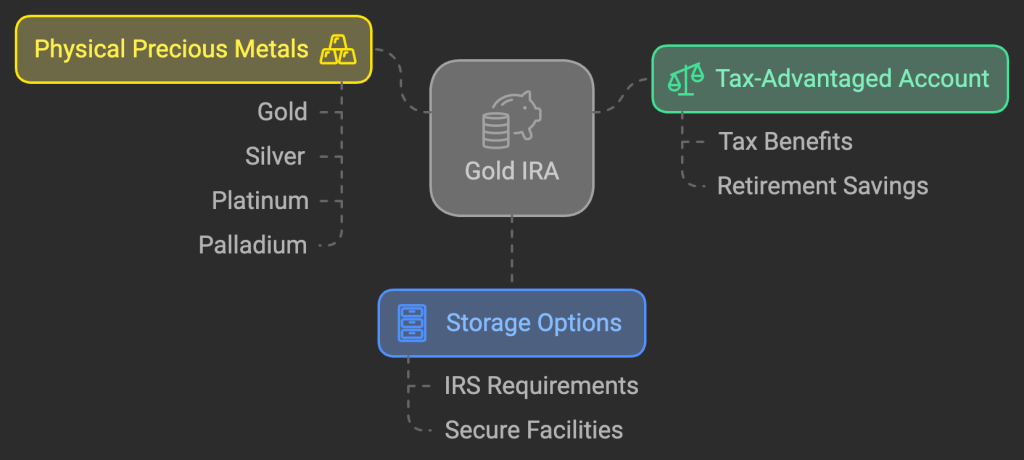
Most reputable gold IRA companies sell you the physical metal directly and arrange the IRS-required storage that comes with it. In most cases, a self-directed IRA like this can hold gold, silver, platinum, palladium, and other precious metals, which gives you a way to diversify away from fiat currency, mutual funds, stocks, and bonds.
A financial advisor can help a first-time gold IRA investor choose the right metals and decide which account type fits, a Roth or a traditional IRA.
Gold IRA Benefits

A gold IRA gives you maximum control over which precious metals go into your account, since it is a self-directed structure.
You also decide how much of your 401(k) you want to move over. Many experienced investors treat gold and silver as one piece of a diversified retirement account rather than the whole thing, and a 401k to gold IRA rollover of about 5 to 20 percent of your retirement savings is a common starting point.
A gold IRA also means less time spent watching stock market swings or worrying about global economic uncertainty compared with holding only mutual funds, stocks, and bonds. Physical gold has a long history of holding value when other asset classes struggle, including during the Great Depression. That track record is a big part of why investors diversify a portion of retirement savings into physical gold and other precious metals during uncertain periods.
IRA-Approved Precious Metals Investments
Only a handful of IRS-approved precious metals qualify for a self-directed gold IRA, so this is one of the most important factors to understand before you roll over any funds.
The Internal Revenue Service generally treats collectibles as a prohibited IRA investment, but Internal Revenue Code section 408(m)(3) carves out a specific exception for gold, silver, platinum, and palladium that meet minimum purity standards. That exception is the reason a retirement account can hold physical metal at all. The IRS sets strict purity and origin requirements for any metal allowed in an IRA:
- Purity must be at least 99.5 percent for gold, 99.9 percent for silver, and 99.95 percent for platinum and palladium.
- Proof coins need a certificate of authenticity, mint condition, and their original packaging.
- Non-proof bullion coins must be free of damage and in excellent uncirculated condition.
- Small bullion bars must match their exact mint weights.
- Bars, coins, and rounds must be certified by an approved assayer or refiner.
A reputable custodian gives you access to a wide range of IRS-approved metals along with the advice and educational resources you need to meet these requirements before you open a gold IRA account.
Gold IRA: An Inflation Hedge
Inflation has been a recurring worry for the world economy, and major currencies such as the US dollar face real pressure to lose purchasing power over time.
A widely used hedge against that risk is precious metals. Historically, physical gold has held up well when other asset classes struggle, which is why diversifying part of a 401k into gold is worth considering as an inflation hedge rather than a bet on any single outcome.
If protecting your retirement savings from inflation matters to you, the gold IRA rollover process itself is simple to start once you have chosen a custodian.
Gold IRA: A Diversification Tool
Beyond the inflation question, spreading retirement savings across more than one asset class is generally a sound risk management practice. If most of your savings already sit in stocks and bonds, adding gold through a self-directed IRA gives you a separate asset class that does not move in lockstep with the market.
That separation is the point. If something goes wrong in one industry or asset class, you still have funds held in a different one. A gold IRA behaves differently from most other investments you might be considering, which is part of why long-term savers use it for diversification.
Gold IRA Rollover from 401(k)
A 401k to gold IRA rollover moves money from your employer-sponsored plan into a self-directed IRA, and the safest way to do it is a direct trustee-to-trustee transfer.
I have done this exact move with my own retirement savings, and the first real decision is not which metal to buy, it is how the money travels from your old plan to your new custodian.
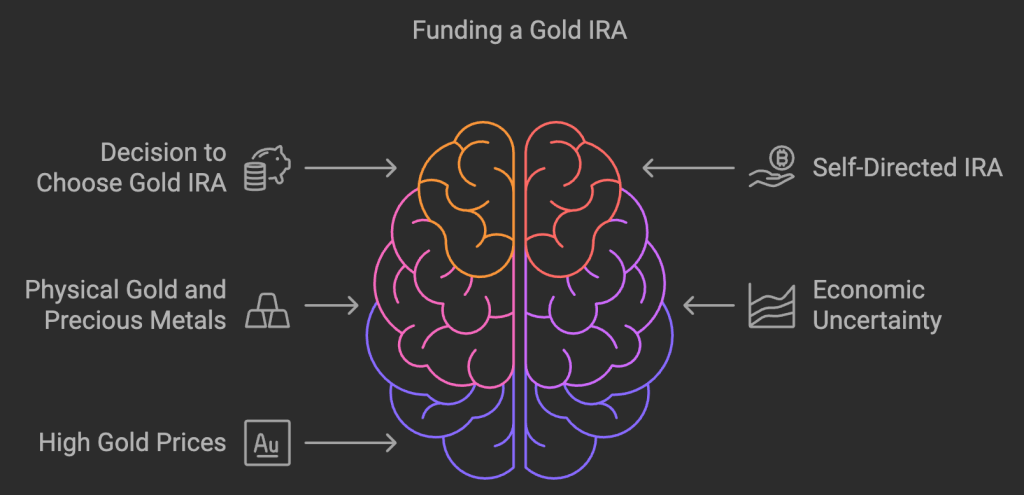
Once you decide a self-directed gold IRA is right for you, the next question is how to fund it. Physical precious metals are expensive, and rising gold prices only add to the amount you need to move. Beyond paying out of pocket, the practical answer for most investors is a gold 401k rollover: moving a portion of retirement savings you already have into the new account instead of coming up with new cash.
A 401k gold IRA rollover means diversifying a chosen portion of your retirement savings into gold and silver. There is more than one way to execute the transfer, and a good custodian walks you through the support and paperwork it takes.
Direct vs. Indirect Rollover: An Overview
As a gold IRA investor, you choose between a direct and an indirect rollover when you fund your precious metal purchase from an existing retirement account.
A direct rollover, also called a direct trustee-to-trustee transfer, moves funds straight from your 401k to the gold IRA custodian’s account without the money ever passing through your hands. That straightforward path is what reduces your risk of taxes and penalties.
The alternative is an indirect rollover. Here, funds from your retirement account are deposited into your personal bank account first, then forwarded to the custodian later.
Indirect rollovers come with two costs to watch. The initial transfer can be subject to a 20 percent tax withholding, and if you do not redeposit the full amount within 60 days, the IRS stops treating it as a rollover and starts treating it as a distribution, which brings penalties and taxes of up to 10 percent on top.
Steps to Execute 401k to Gold IRA Rollover
The IRS penalties for a misstep are steep, so it pays to move carefully through a gold IRA rollover.
Selecting a Reliable Gold IRA Company
Your rollover, and everything that follows, depends on the gold IRA company you choose as custodian. Without solid advice, education, and infrastructure behind you, it is hard to get the full benefit of a gold-based self-directed IRA.
When selecting a gold IRA company, weigh account management fees, minimum investment requirements, the range of metals offered, and access to IRS-approved depositories, such as the Delaware Depository in Wilmington, Delaware.
Opting for a Self-Directed Custodian
The custodian you choose determines how much control and responsibility you carry in managing the account.
Some custodians handle nearly everything for you, which is not always what investors who want direct control over their gold IRA are looking for. In that case, a self-directed custodian is usually the better fit.
A self-directed custodian is responsible for holding your precious metals under IRS rules and administering them into your account, but the choice of which metals to buy, and the account’s performance, is on you.
Opening an Account with a Gold IRA Custodian
Opening a gold IRA account is straightforward with a competent custodian. Most of the time, it is a short registration and verification process.
Your custodian should walk you through the IRS regulations that govern gold IRAs. Once your account is active, you can start deciding which metals to buy and how you plan to fund the purchase.
Implementing the Rollover
Precious metals IRAs can be costly to start, so decide early where the money is coming from. For most investors, that means a gold IRA rollover. Choose direct or indirect based on your situation, then get the paperwork moving.
With the right custodian handling the process, your main job is to tell your 401k account manager you intend to roll over funds. They release the money or transfer it directly to your custodian.
Track the transfer from the moment it leaves your 401k until it lands in your custodian’s account. Depending on the company you work with, you may also need to sign paperwork to approve the rollover.
Buying Gold for IRA
Once your account is funded, it is time to choose your metals. Physical gold remains the most popular choice among gold IRA investors, but silver and platinum are options too.
Palladium, a major component in catalytic converters and electronics, is worth a look given ongoing industrial demand. Silver offers a cheaper entry point that gets overlooked next to gold’s popularity.
Whichever metal you choose, confirm it comes from a reputable source and meets the IRS purity requirements before you buy.
Gold IRA Rollover: Potential Risks
Conducting a gold IRA rollover carries two main risks worth planning around: IRS penalties and fraud.
IRS penalties usually hit when rollover funds sit in your bank account for more than 60 days. Once that window closes, the IRS treats the money as a distribution rather than a rollover and penalizes you for an early withdrawal from your 401k.
Fraud is the other risk, and it shows up in two forms. If you do not research your chosen gold IRA company carefully, you risk sending funds to an entity that does not actually exist. And if you buy from an untrustworthy precious metals dealer, you risk ending up with fake metal, or metal that does not qualify for a gold IRA in the first place.
Tax Implications of Gold IRA
A direct 401k to gold IRA rollover triggers no taxes on its own, but how you handle the transfer determines whether the IRS ever gets involved.
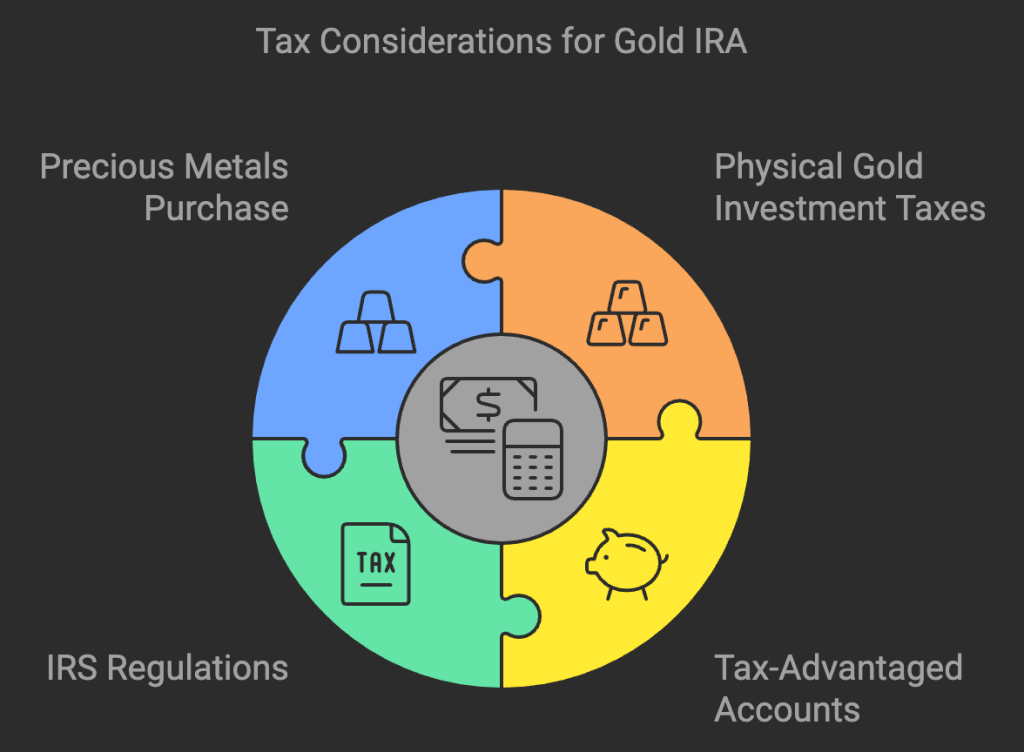
Taxes are part of owning physical gold, even inside a tax-advantaged retirement account. The IRS still has a say. Here is what to weigh before you buy precious metals for your gold IRA.
Taxation of Gold in an IRA
How your gold IRA is taxed depends on the account type you choose, typically a gold Roth IRA or a traditional gold IRA.
With a Roth IRA, you pay taxes when you deposit funds to buy gold. In exchange, withdrawals are tax-free as long as you take them at the right time, meaning after you reach retirement.
A traditional gold IRA works the opposite way. Deposits go in tax-free, and the IRS collects taxes only when you make withdrawals.
Tax-Free 401k to Gold Conversion
The biggest tax advantage of a 401k gold IRA rollover is that a direct transfer is not a taxable event. It is treated as if the money never left your retirement savings.
An indirect rollover is different. Funds transferred from a 401k to a gold IRA through the indirect route can be taxed. If your only goal is buying gold bullion, a direct rollover is the better option on tax grounds alone.
Tax Penalties for Early Withdrawal
Penalties only apply if 401k funds sit in your bank account for more than 60 days.
The rollover process can stretch out, which is one reason your gold IRA custodian needs to be organized, with the paperwork, infrastructure, and staff ready before you start the rollover.
For more on how gold IRAs are taxed, see the gold IRA tax rules page.
Considerations for Gold IRA Rollover
Choosing to roll a 401k into gold means weighing the custodian’s minimum investment, its fee structure, and how much hands-on control you actually want.
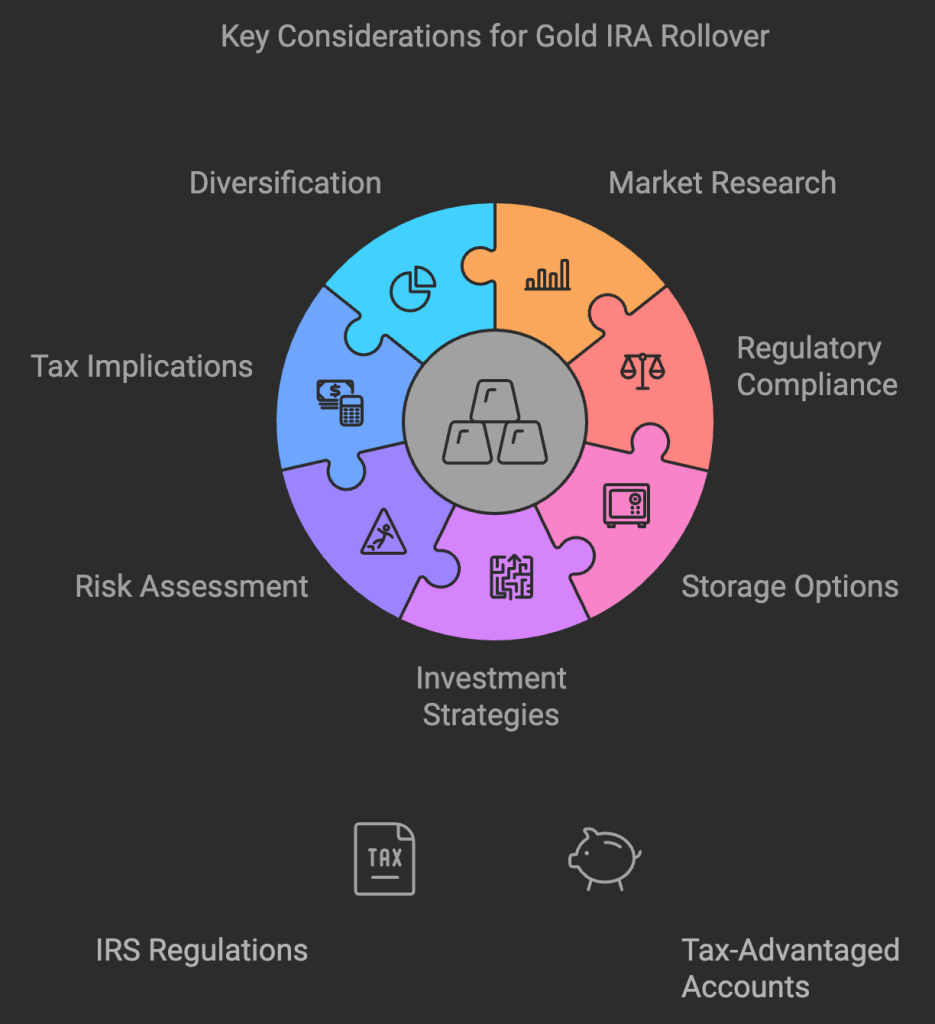
A gold investment is not a decision to make on the spur of the moment. A few things are worth thinking through first.
Risks of Self-Directed IRAs
Full control over your retirement account is valuable, but it also opens the door to financial miscalculations that an experienced custodian would likely avoid.
Choosing a self-directed IRA means committing more time and effort to managing the account than you would with a traditional 401k where someone else makes the calls.
Gold IRA Account: Minimum Investment Requirement
Every custodian sets its own minimum investment requirement, which determines how much you need to roll over from your 401k to get started.
If a custodian’s minimum sits above your comfort zone, you may end up rolling over more than the recommended 5 to 20 percent of your 401k, which can meaningfully affect the rest of your retirement account.
Gold IRA Withdrawal Rules
As with any retirement account, the IRS controls when you can access the money without triggering penalties or, in some cases, taxes.
In most cases, you keep the money in the account until retirement, so treat this as a long-term decision. If you expect to need the funds sooner, a gold IRA is not the right home for them.
Evaluating Storage and Security of Gold
One thing that gives potential investors pause is the IRS rule on storage. Any gold you buy for a retirement account has to sit in an IRS-approved depository.
That is the safer option, but it also means gold IRA investments carry additional storage fees charged to the account.
Understanding Fees and Charges
To know whether a gold IRA rollover is worth it for you, add up the fees that come with the move.
The most common fees, depending on the custodian, include:
- Account setup
- Management
- Rollover
- Storage
High fees can erase the benefits you expected from diversifying into gold. A good custodian keeps its fee structure transparent so you know exactly what you are paying and why.
Conclusion
The bottom line: a 401k to gold IRA rollover is a straightforward way to diversify retirement savings into physical metal, provided you use a direct trustee-to-trustee transfer and a reputable custodian.
The economic backdrop since the COVID-19 pandemic has not been kind to investors holding only fiat currency and paper assets, which is part of why a growing number of savers look for an alternative. If you are looking for a way to protect your financial future, a 401k to gold IRA rollover is one option worth weighing seriously.
Companies such as Goldco Precious Metals work with investors through the process. As with any major investment decision, weigh the pros and cons of diversifying this way before you commit. The gold IRA company you choose as custodian is one of the biggest factors in how that goes.
Gold401k covers this territory in depth, from the mechanics of a 401k to gold rollover to the custodians who handle it.
Frequently Asked Questions
Yes, you can roll a 401k into a gold IRA using a direct trustee-to-trustee transfer, and these are the specific questions investors ask most before they start.
Can I Roll My 401k to a Gold IRA?
Yes. Rolling funds from a 401k into a gold IRA is one of the most common ways to fund a precious metals purchase. The process is straightforward, and a direct rollover comes without extra taxes or penalties to your retirement portfolio.
The key to a successful 401k to gold rollover is finding the right custodian. A strong team behind you means access to real advice, education, and a solid range of precious metals.
Should I Put My 401k Into Gold?
Diversifying into gold is easy with the right company, but deciding whether to do it takes more thought.
Weigh your investment goals, how much you have in your 401k, and how many years you have left until retirement. Talking it through with a financial advisor is a reasonable step before you commit.
How Does a Gold IRA Rollover Work?
In simple terms, a gold IRA rollover transfers money from an existing retirement account into a precious metals IRA. An IRS-approved precious metals custodian handles it, either as a direct or an indirect rollover.
That means funds move either straight from your 401k to your gold IRA, or through your bank account for up to 60 days before landing with the custodian. Either way, the paperwork is minimal and does not take much of your time.
What Is the Minimum Investment Required to Open a Gold IRA Retirement Savings Account?
Every custodian sets its own minimum investment requirement, usually based on the type of investor it targets. With some research, you can find a custodian whose minimum fits your budget. Noble Gold is one option worth considering if you are a new investor looking for a more accessible entry point.
Can I Store the Gold From My Gold IRA at Home?
No. The IRS specifically prohibits storing IRA-owned precious metals at home. You have to use an IRS-approved depository, and that comes with additional storage fees charged to the account. Metal stored at home counts as a distribution, which triggers an early withdrawal penalty.
More Gold Investing Guides
If you want to go deeper on any of these topics, these guides are a good next stop:
- Tax Benefits of Precious Metals: What Every Investor Should Know
- Gold Star IRA Review
- Can I Invest in Gold Through Fidelity?
- Short-term Gold Trading: Definition and Tips for Success
Gold401k may earn a commission if you click through to a company reviewed elsewhere on this site, which does not change the educational content above. Always consult your own tax and financial professionals before moving retirement funds.
By Tim Schmidt + Sean Webster
Reviewed by Sean Webster